

Depending on its use, AI can make a brand feel more helpful — or less trustworthy. Our research suggests the difference often comes down to one question:
Is AI working for the consumer, or making decisions about them?
Across C+C’s February and August 2026 Consumer AI surveys, that dividing line was steady. Consumers in the US were likelier to trust brands more when AI improved a product or service. They were consistently more wary when brands gave AI control over decisions such as pricing or approvals.
For brands, this is more of a reputation issue and less a technology issue.
AI can build trust when consumers see it working on their behalf
Fraud and security protection is one of the clearest examples.
Consumer trust in brands using AI for security and protection against fraud increased over the six-month period. When we asked about specific scenarios in August, flagging potentially fraudulent account or purchase activity emerged as the strongest brand trust builder.
Brand use of AI for fraud protection offers a clear consumer benefit. The technology is helping protect the customer, rather than evaluating them.
This is where AI can be an asset to brand trust, working behind the scenes to solve a problem, protect people, or improve an experience.
The trust equation changes when AI becomes the gatekeeper
The picture looks very different when AI determines what a consumer does, or does not, get.
In the August survey, more than half of respondents said they would trust a brand less if AI approved or denied applications, claims, refunds, or returns. They also reacted negatively to brands using personal information to predict future behavior, set prices, or determine rates and fees.
Recent airline industry headlines show how quickly AI-assisted pricing can become a reputation issue. The practice has drawn public and political scrutiny, even as an airline involved has emphasized that its AI system supports human analysts rather than setting individualized fares based on personal data.
That concern mirrors our research: consumers are far more cautious when AI influences prices or other outcomes that directly affect them.
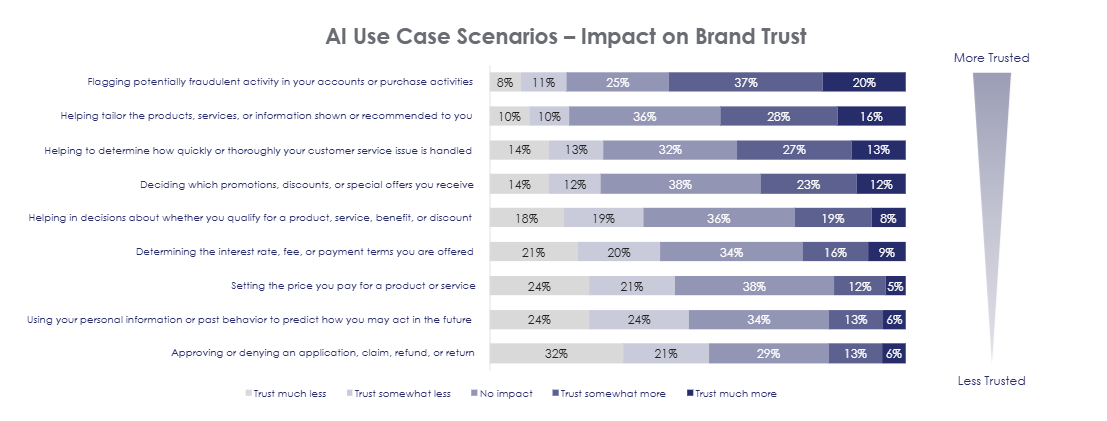
For brands, these are decisions around customer experience and reputation, not simply choices about technology.
And they reinforce the value of keeping a human in the loop. The higher the stakes, the more important it becomes for consumers to understand what happened, reach a real person, and have a concrete way to challenge an outcome.
Women sharpen the distinction
Women were particularly sensitive to AI acting as a gatekeeper for brands. Nearly six in ten said they would trust a brand less if AI approved or denied an application, claim, refund, or return (higher than among men).
The implication is not that women distrust every scenario a brand might use AI. Quite the opposite: their responses help illustrate the broader pattern. Protecting the consumer can earn trust. Exercising power over the consumer can put trust at risk.
Where brands can build or lose trust:
| Industry | Potential trust builder | Potential trust risk |
| Health | Helping clinicians identify risks or reducing administrative work | Influencing treatment or coverage decisions without a human review |
| Banking | Detecting fraud and suspicious activity | Determining credit, rates, or fees (approvals or rejections) |
| Travel | Helping customers rebook during disruptions or finding relevant options | Using AI to inform pricing or deny refunds without clear explanation or human oversight |
| Education | Identifying where students may need support | Making consequential admissions, grading, financial, or other learning aid decisions |
| Online shopping | Improving search and recommendations, fraud protection | Hidden dynamic pricing or unexplained account restrictions |
| Marketing | Making information more relevant and useful | Targeting based on sensitive known or inferred vulnerabilities |
| Nonprofit & sustainability | Identifying service needs or improving resource allocation | Automatically determining who receives assistance |
The examples differ by sector, but the underlying question is the same: How much authority should AI have?
Before deploying a consumer-facing use of AI, brands should consider whether it is assisting or deciding, what happens if it is wrong, whether consumers can understand the outcome, and whether a human can step in as needed.
The use of AI can strengthen brand trust when it protects people, expands their options, or improves their experience. But when it becomes an invisible gatekeeper with the power to price, predict, approve, or deny, the technology can quickly become a brand liability.
About the C+C Market Intelligence team
Our Market Intelligence team specializes in delivering data-driven insights and strategic marketing communication solutions that drive measurable behavioral change. The team is comprised of a group of talented researchers with a variety of skill sets and competencies across qualitative and quantitative research. If you have any questions about our work, get in touch: