

AI use can strengthen a brand’s reputation when consumers see how it improves their experience. Without clear benefits and appropriate safeguards, brands risk increasing skepticism among their audiences.
AI has had no shortage of attention in the past six months. Concerns about the energy and water needed to power data centers have moved into the national conversation, while the dramatic increase in AI-generated content has raised new questions about what consumers can trust. Yet through all of that, Americans’ overall feelings about using AI in everyday life have barely moved.
That may be the more interesting story.
C+C surveyed over 160 consumers across the U.S. in February and again in August 2026. In both surveys, roughly half felt positive about the use of AI in everyday life. Consumers do not appear to be broadly embracing or rejecting the technology. Instead, they are becoming more discerning about what brands do with it.
AI adoption alone won’t win consumers over
One shift is worth watching: the share of consumers who said a company’s use of AI would make them feel more positive about that brand fell from 24% in February, to 18% in August. Most consumers, meanwhile, still say knowing a brand uses AI does not change their opinion either way.
For communicators, there is an important reminder here that extends well beyond AI: the technology is rarely the story. The benefit is.
Every new technology arrives with a mix of excitement and uncertainty, but consumers ultimately care about what changes for them. Does it make a service faster? Information easier to find? An account more secure? A complicated process simpler?
Brands should resist treating “AI-powered” as a benefit on its own. Instead, explain the problem being solved and why the consumer experience is better because of it.
Women are an audience brands should watch closely
Our research found that women stand out as a more skeptical audience. They are less positive overall about the use of AI in everyday life, and in August, were about twice as likely to say a brand’s AI use would make them feel more negative rather than positive about the company compared to men.
That does not mean brands should assume women reject AI – rather, they may have a higher burden of proof when it comes to its potential benefits.
For brands trying to build credibility, broad promises about “responsible use of AI” are unlikely to do the work on their own. Show consumers what the use AI is doing, where humans remain involved, how their information is handled, and what happens if an automated process gets something wrong.
Healthcare shows how quickly the story can change
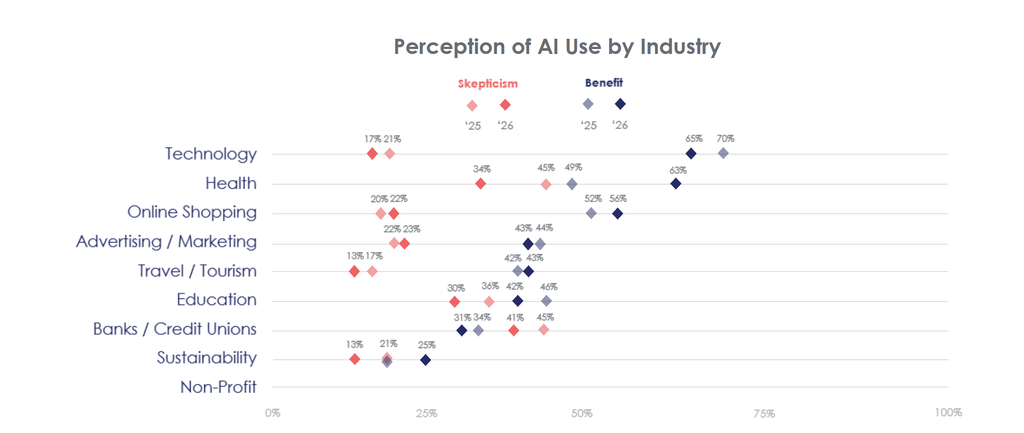
The industry findings offer perhaps the most interesting six-month shift.
Technology is still widely associated with benefiting from the use of AI, but enthusiasm softened somewhat. Healthcare moved sharply in the other direction: the share seeing a benefit from AI rose from 49% to 63%, while skepticism fell from 45% to 34%.
Consumers themselves point to why this shift has happened. As one respondent put it:
“In healthcare, it helps with early diagnosis, personalized treatments, and faster patient care.”
But opportunity and skepticism can coexist. Another respondent cautioned:
“I would really want real people to do their due diligence with health-related matters.”
Consumers can see tremendous potential in AI while still wanting a real person involved when the stakes are high.
Banking remains another clear example: skepticism continues to outweigh perceived benefit due to the sensitive nature of consumers’ personal financial data.
Sustainability and nonprofits tell a different story. Neither generates especially strong perceptions of benefit or skepticism. For organizations in those sectors, that relative blank slate may be an opportunity: brands still have room to demonstrate where AI creates tangible value before stronger opinions take hold.
What brands should take away from the research
AI use can strengthen a brand’s reputation when consumers can clearly see how it improves their experience. But when the benefit is unclear, or when consumers question how decisions are made, brands risk creating skepticism and undermining credibility.
That means the communications fundamentals should not change simply because the technology has. Know your audience and lead with the human benefit. Back up broad promises with specifics. And when AI has the power to affect something consequential, make the safeguards and involvement of real people clear.
About the C+C Market Intelligence team
Our Market Intelligence team specializes in delivering data-driven insights and strategic marketing communication solutions that drive measurable behavioral change. The team is comprised of a group of talented researchers with a variety of skill sets and competencies across qualitative and quantitative research. If you have any questions about our Market Intelligence team, get in touch here: